 Souva
It takes about two months to form a habit, on average. The best-known study found a median of 66 days for a daily behavior to feel automatic, with a range from 18 to 254 days. The popular "21 days" is a myth. Simple habits can form in weeks; harder ones like exercise often take months.
So how long does it take to form a habit? Long enough that most people quit too early, thinking they failed. This guide walks through the real studies, from the 66-day paper to a 2024 review, explains what "automatic" means, what happens when you miss a day, and how to use all of it.
How long does it take to form a habit, according to research?
66 days: the median time for a new daily behavior to reach its peak automaticity. The range was 18 to 254 days.
Lally et al., European Journal of Social Psychology, 2010In the study by Phillippa Lally and colleagues at University College London, 96 volunteers picked one eating, drinking or activity behavior and did it once a day in the same situation, such as "after breakfast," for 12 weeks. Every day they rated how automatic it felt.
Automaticity rose fast at first, then leveled off. The researchers measured how long each person took to reach 95% of their own plateau. The median was 66 days. But one person got there in 18 days, and for another the model predicted 254 days.
A few caveats keep this honest. The curve fit well for only 39 of the 82 people who gave enough data. Habits were self-rated. And the behaviors were simple ones.
A middle value of 66 days doesn't mean your habit will be done on day 66.
Where does the 21-day myth come from?
It comes from Maxwell Maltz, a plastic surgeon, and his 1960 book Psycho-Cybernetics. He noticed that patients took about 21 days to get used to a new face. He wrote that it usually takes "a minimum of about 21 days" to see a change in a mental image.
Two things got lost on the way to self-help posters. Maltz was talking about self-image, not habits. And he said a minimum, not a finish line.
No study of habits has found 21 days as a typical number.
What newer studies found
Since 2010, more studies have measured habit time in different ways. They agree on one thing: there is no magic number.
| Study | Behavior | Time to habit |
|---|---|---|
| Lally et al., 2010 | Daily eating, drinking or activity (82 people with data) | Median 66 days; range 18 to 254 |
| Kaushal and Rhodes, 2015 | Exercise, 111 new gym members | At least 4 sessions a week for 6 weeks as the minimum |
| Fournier et al., 2017 | Daily stretching | Mean 106 days in the morning, 154 days in the evening |
| Keller et al., 2021 | Healthy eating | Median 59 days; range 4 to 335; only 23% reached the threshold |
| Buyalskaya et al., 2023 | Gym visits, 30,110 gym goers | Median about 4 to 7 months |
| Buyalskaya et al., 2023 | Handwashing, 3,124 hospital workers | A couple of weeks (9 to 10 shifts) |
| Singh et al., 2024 (review) | 20 studies, 2,601 people | Medians 59 to 66 days; means 106 to 154 days |
The 2024 systematic review by Singh and colleagues is the best summary so far. It concluded that habits "can start forming within about two months," and that the time varies a lot between people. It also found that habits done in the morning, and habits people chose for themselves, tended to be stronger.
The 2023 study in PNAS used machine learning on millions of real records, not self-reports. Gym habits took months. Handwashing took weeks. The likely reason: handwashing is simple and happens many times a day, while the gym is less frequent and more complex.
What is automaticity, and why does it matter?
A habit is not something you do often. It is something you do without deciding. Researchers call that automaticity: the situation triggers the action before you think about it. You don't decide to brush your teeth after breakfast. You just do.
That trigger is a cue. A good cue is something that happens every day at about the same point: waking up, pouring coffee, sitting on the train, closing the laptop.
In Lally's study, every habit was tied to a cue like "after breakfast." Repeat the same action after the same cue, and the link grows stronger each time.
This is why the curve flattens. The first weeks bring big gains. Later repetitions add less, because the link is already strong. It is also why "doing it more" isn't the goal. Doing it in the same situation is.
Does missing a day ruin a habit?
No. This is the most useful finding in the whole field. In Lally's study, "missing one opportunity to perform the behaviour did not materially affect the habit formation process." A follow-up article by the same team says that automaticity gains "soon resumed" after one missed day.
What does hurt is drift. In the PNAS gym data, for 76% of people, the longer it had been since their last visit, the less likely they were to go on a given day.
One gap is a blip. A week of gaps starts a new pattern.
So the real danger of a missed day is how you react to it. If one miss makes you feel the streak is "ruined" and you stop, the miss did the damage through you. Plan for misses from the start.
Practical rules for forming a habit
- Pick one small action. "Read two pages," not "read more." Simple actions became automatic faster in the studies.
- Tie it to a daily cue. Write it as "After I [cue], I will [action]." Use something that happens every day at the same place.
- Plan for at least 10 weeks. Two months is a fair median. Exercise and complex routines can take 4 to 7 months.
- Try the morning. Morning habits were stronger in the 2024 review, and in one study morning stretching formed weeks faster than evening stretching.
- Never miss twice. One miss is fine. Get back on the next day, before a gap becomes the new routine.
- Remove the competition. A habit has to beat whatever else is in that slot. If your phone fills that slot, lock it for that time. See how to stop doomscrolling.
- Track the doing, not the feeling. A simple daily check gives you a record when the habit still feels like effort.
How NoMercy's plans fit the research
NoMercy is our habit app, so take this part as ours. We built its rules around the findings above. That doesn't mean the app itself was tested in a study; it hasn't been.
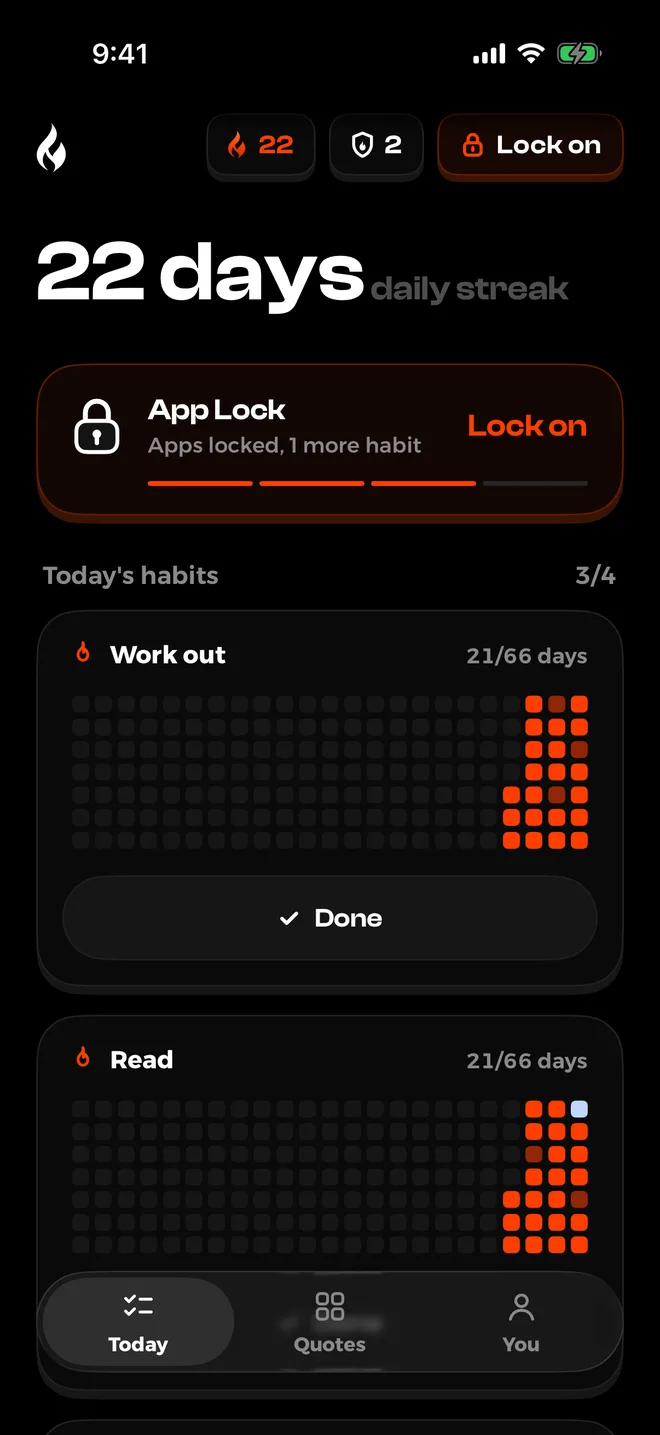
- Plans of 14, 21, 30 or 66 days. The 66-day plan matches Lally's median. The shorter plans are good starts for simple habits, not a promise that the habit is done. New habits arrive as the plan moves on, so you build one link at a time.
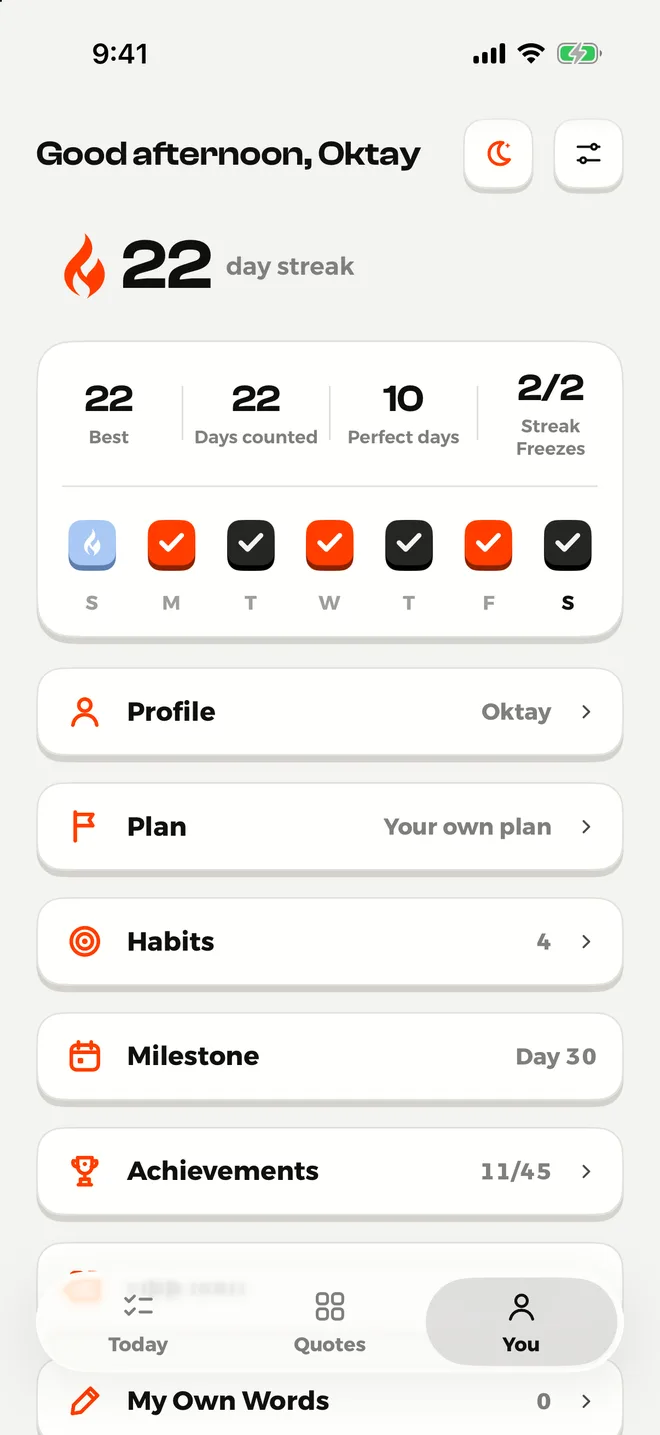
- A day counts at half. Your streak counts a day when you finish half of today's habits. Finishing all of them is a perfect day. One weak day doesn't erase your record, which matches the finding that one miss doesn't erase progress.
- 2 Streak Freezes a week. A freeze covers a missed day. It fits the "never miss twice" rule: the miss is covered, and you are back the next day.
- Pause for up to 30 days. Illness or travel doesn't wipe your streak.
- Locks for the slot. The App Lock can keep chosen apps locked until you finish a habit, so the phone doesn't win the morning.
Honest limits: plans need Premium (there is a free trial; then $3.99 a week, $6.99 a month, $29.99 a year or $59.99 once). The free version covers up to 3 of your own habits, Streak Freezes, focus sessions and a night lock. It is iPhone only, iOS 18.6 or later.
And a streak is a record of doing, not proof of automaticity: only you can tell when the habit runs itself. For other options, see the best habit tracker apps for iPhone.
See NoMercy on the App StoreBuilding a phone-free start to the day? Read how to build a morning routine without your phone and how to reduce screen time on iPhone.
Sources
- Lally, van Jaarsveld, Potts and Wardle, How are habits formed: Modelling habit formation in the real world, European Journal of Social Psychology, 2010
- Gardner, Lally and Wardle, Making health habitual: the psychology of habit-formation and general practice, British Journal of General Practice, 2012
- Singh, Murphy, Maher and Smith, Time to Form a Habit: A Systematic Review and Meta-Analysis, Healthcare, 2024
- Buyalskaya et al., What can machine learning teach us about habit formation? Evidence from exercise and hygiene, PNAS, 2023
- Kaushal and Rhodes, Exercise habit formation in new gym members: a longitudinal study, Journal of Behavioral Medicine, 2015
- Gardner, Busting the 21 days habit formation myth, UCL Health Behaviour Research Centre, 2012
- How to form a habit, BPS Research Digest
Questions
Is it true that it takes 21 days to form a habit?
No. The 21-day idea comes from a 1960 self-help book by plastic surgeon Maxwell Maltz, who wrote that it takes a minimum of about 21 days to notice a change in your self-image. Studies that measured habits found a median of about 66 days, with a range from 18 to 254 days.
How long does it take to break a bad habit?
The studies in this guide measured forming new habits, not breaking old ones, so there is no good number. A practical approach is to put a new action after the same cue that used to start the old one, and to expect weeks to months, not days.
Does missing one day reset a habit?
No. In the 2010 study by Lally and colleagues, missing one chance to do the behavior did not materially affect habit formation. Long or repeated gaps are what hurt.
Why do some habits form faster than others?
Simple, frequent actions in a stable situation become automatic faster. Drinking a glass of water after breakfast forms faster than a gym routine. Handwashing at work formed in about two weeks in one study; gym habits took about 4 to 7 months.
What is the 66-day rule?
It is the median time participants in Lally's 2010 study took to reach their peak automaticity for a new daily behavior. It is a middle value, not a promise: half of people took less time and half took more.